
Oceania Planet
A phygital fantasy-ocean park built as a persistent interactive world in Unity—projected into physical space and played through presence, gestures, and lightweight games.
My role: Art Director shaping the visual language, interaction design, and experiential structure across zones.
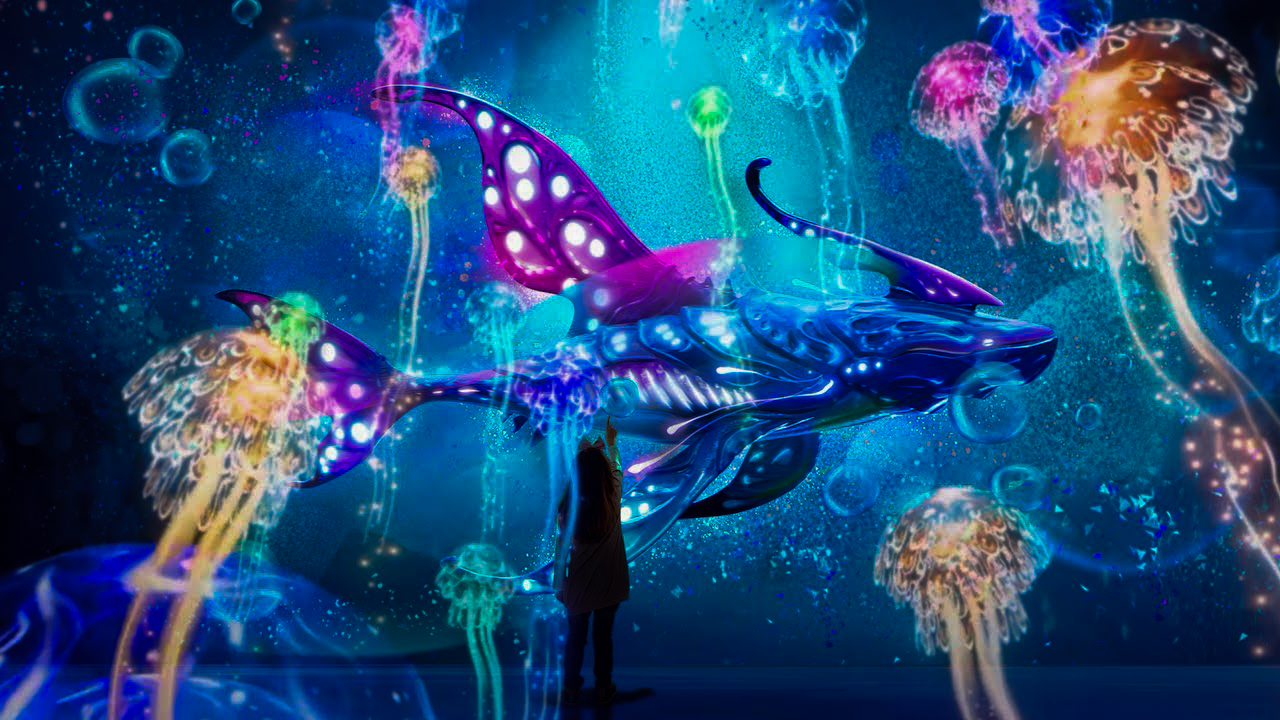
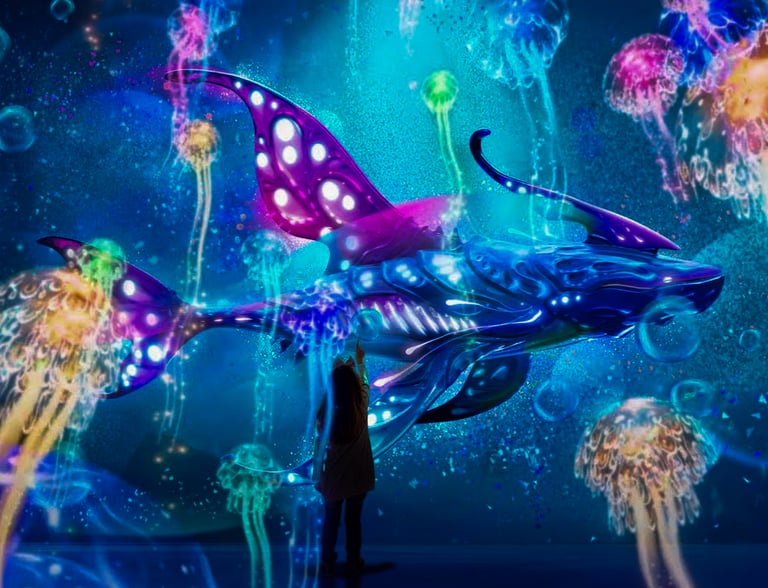
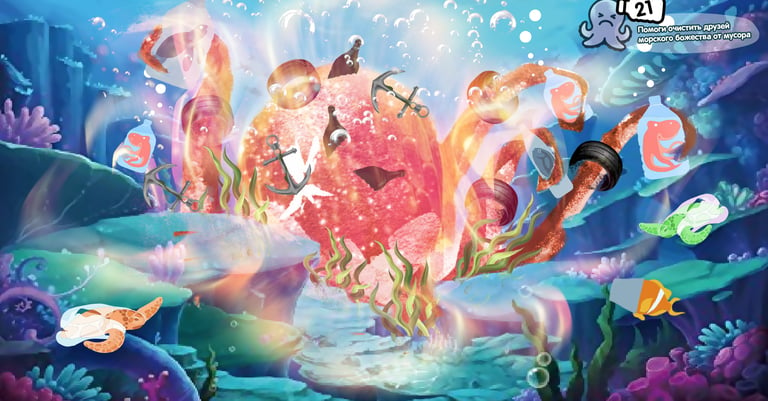
Oceania Planet was created as a whole-family entertainment experience themed around an extraterrestrial ocean—its flora, fauna, and the feeling of gradually descending into unknown depth. The park was composed of multiple rooms and installations: reactive projection environments, short game-like interactions, and a large show-driven zone that blended puzzle play with a cinematic payoff.
Although delivered as a physical attraction, the production process and the result were game-native. The park ran as a set of real-time interactive worlds built in Unity, using familiar pipelines: concept and asset production, scene assembly, animation, VFX, gameplay logic, and iteration against performance constraints. The main difference was the interface: projected surfaces instead of a screen, and sensors (RFID, laser touch, cameras/gesture recognition) instead of a controller.
A phygital fantasy-ocean park built as a persistent interactive world in Unity—projected into physical space and played through presence, gestures, and lightweight games.
My role: Art Director shaping the visual language, interaction design, and experiential structure across zones.
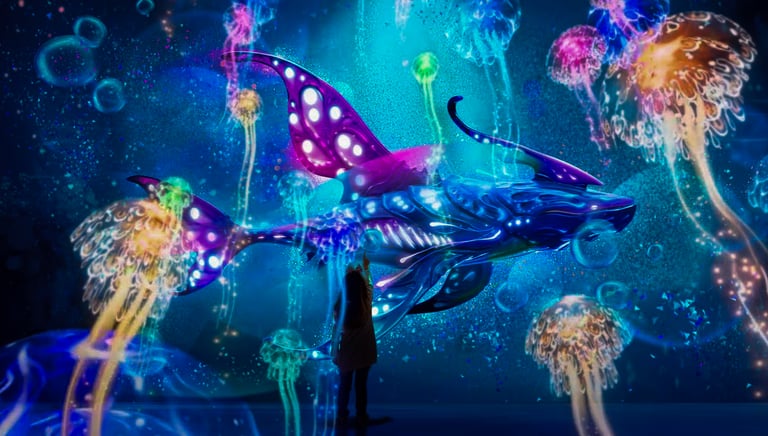
Oceania Planet was created as a whole-family entertainment experience themed around an extraterrestrial ocean—its flora, fauna, and the feeling of gradually descending into unknown depth. The park was composed of multiple rooms and installations: reactive projection environments, short game-like interactions, and a large show-driven zone that blended puzzle play with a cinematic payoff.
Although delivered as a physical attraction, the production process and the result were game-native. The park ran as a set of real-time interactive worlds built in Unity, using familiar pipelines: concept and asset production, scene assembly, animation, VFX, gameplay logic, and iteration against performance constraints. The main difference was the interface: projected surfaces instead of a screen, and sensors (RFID, laser touch, cameras/gesture recognition) instead of a controller.
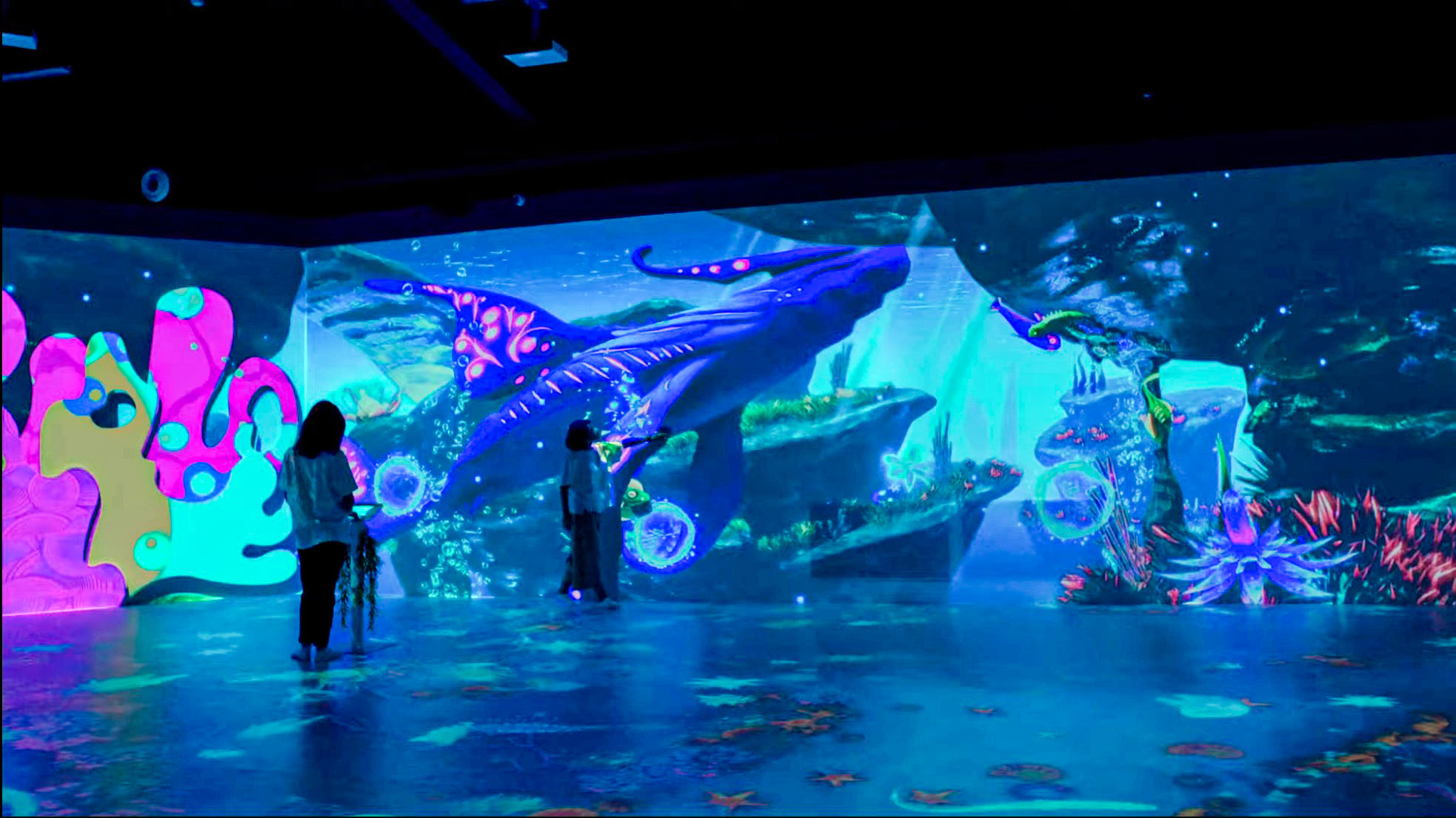
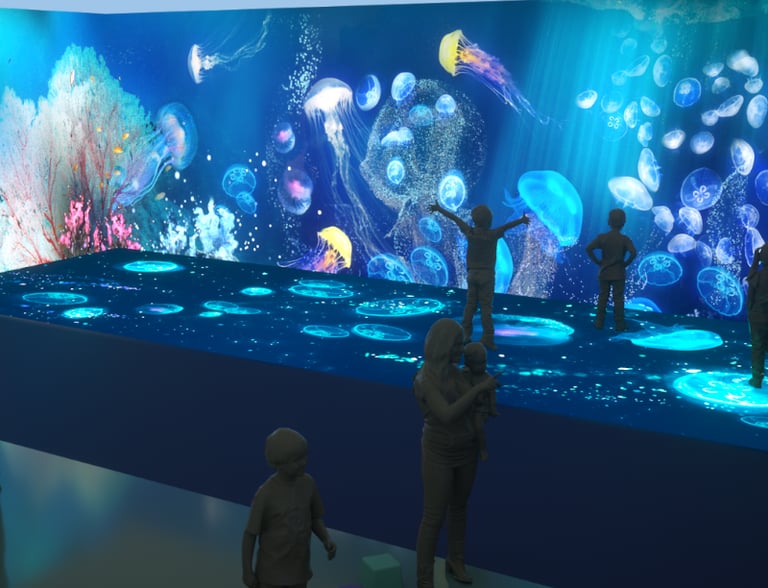
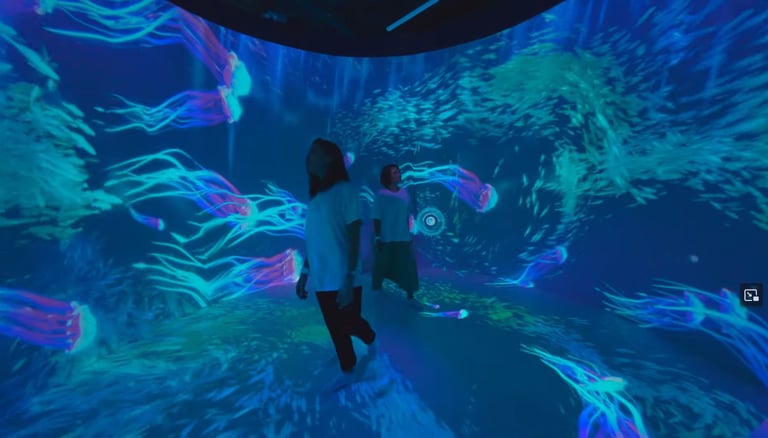
Oceania Planet was designed as a continuous journey through a fantasy ocean world, unfolding across multiple connected spaces with large-scale projections on walls, floors, and semi-transparent surfaces. The experience was structured to progress from lighter, welcoming environments into darker, deeper spaces, using changes in light, scale, and motion to guide emotional pacing rather than explicit narrative cues.
From the entrance, the park introduced the idea of personal continuity. Each visitor created a creature avatar that became their persistent presence in the world, reappearing across different spaces and evolving visually through interaction. This system allowed the park to remember returning visitors and reinforced the sense of belonging within the environment, rather than treating each visit as an isolated session.
Experience Context
Interaction throughout the park was based on direct physical action and immediate visual response. Environments and creatures reacted to movement, gestures, and proximity, making cause and effect readable through observation. The focus was on intuitive discovery, allowing visitors of different ages to understand how the world responds without relying on instructions or interface elements.
The overall experience alternated between moments of active participation, atmospheric transitions, and large-scale show sequences triggered by visitor behavior. Some spaces encouraged brief, repeatable interactions, while others emphasized mood and scale. This balance supported both active players and observers, keeping the world visually alive and coherent regardless of how much a visitor chose to engage.
Oceania Planet was designed as a continuous journey through a fantasy ocean world, unfolding across multiple connected spaces with large-scale projections on walls, floors, and semi-transparent surfaces. The experience was structured to progress from lighter, welcoming environments into darker, deeper spaces, using changes in light, scale, and motion to guide emotional pacing rather than explicit narrative cues.
From the entrance, the park introduced the idea of personal continuity. Each visitor created a creature avatar that became their persistent presence in the world, reappearing across different spaces and evolving visually through interaction. This system allowed the park to remember returning visitors and reinforced the sense of belonging within the environment, rather than treating each visit as an isolated session.
Experience Context
Interaction throughout the park was based on direct physical action and immediate visual response. Environments and creatures reacted to movement, gestures, and proximity, making cause and effect readable through observation. The focus was on intuitive discovery, allowing visitors of different ages to understand how the world responds without relying on instructions or interface elements.
The overall experience alternated between moments of active participation, atmospheric transitions, and large-scale show sequences triggered by visitor behavior. Some spaces encouraged brief, repeatable interactions, while others emphasized mood and scale. This balance supported both active players and observers, keeping the world visually alive and coherent regardless of how much a visitor chose to engage.
Narrative & Experiential Direction
I shaped Oceania Planet as a narrative journey that unfolds through space rather than explicit storytelling. The experience progresses from calm, inviting environments into darker and more uncertain depths, and later resolves toward openness and light at the surface. This arc guided decisions about lighting, color saturation, creature presence, motion intensity, and sound across all zones, allowing visitors to perceive a complete journey even when moving freely or encountering spaces out of order.
key decisions & Contribution
Persistent Character & Progression Systems
I shaped the concept and structure of the visitor character system: a creature created at the entrance, linked to an RFID bracelet, and summonable in multiple zones. The character reacted to gestures, appeared near the visitor inside projection spaces, and evolved visually through interaction and mini-games. Persistence across visits was a core part of the design, allowing returning visitors to reuse and develop the same character over time rather than starting from zero.
Art Direction & World-Building
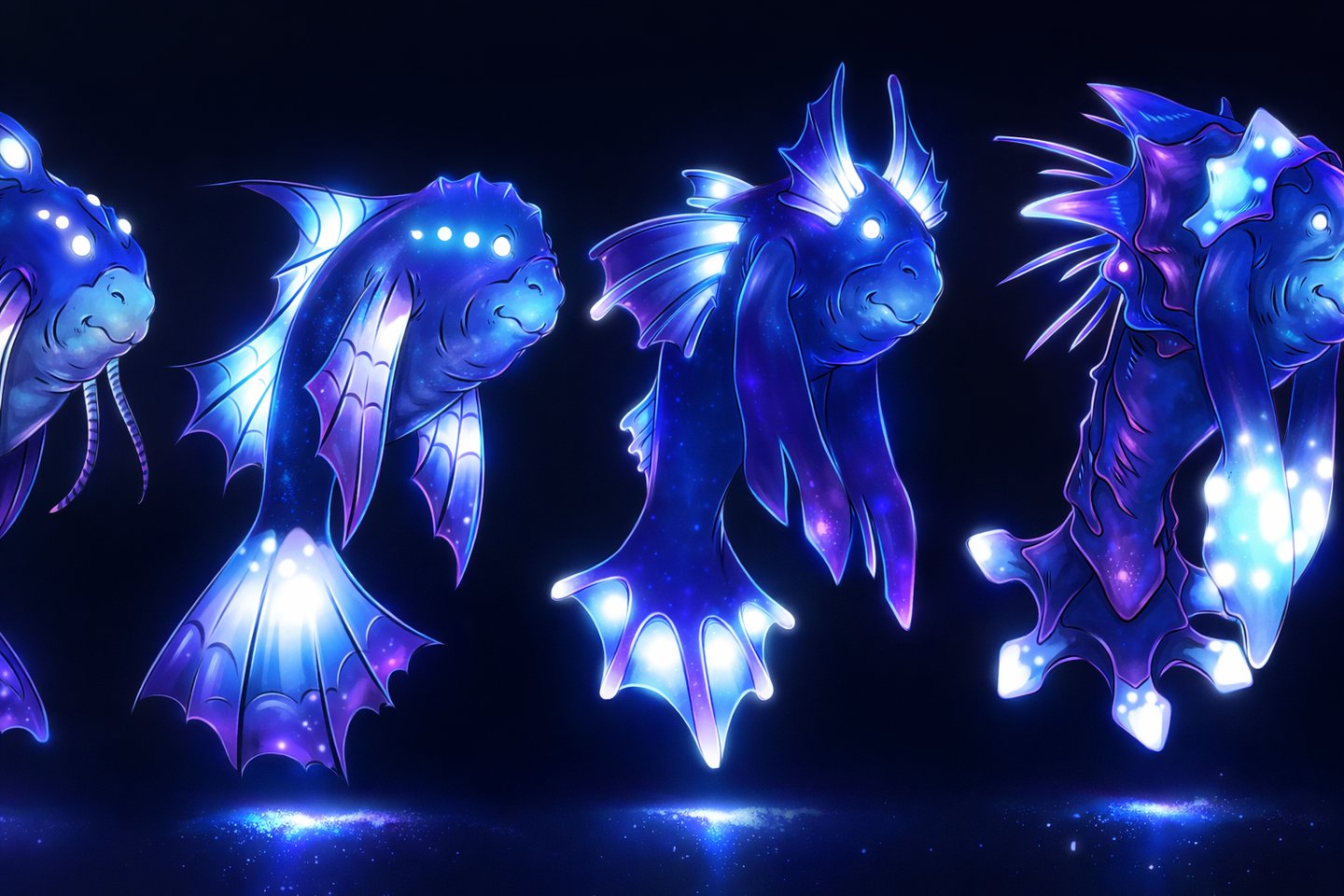
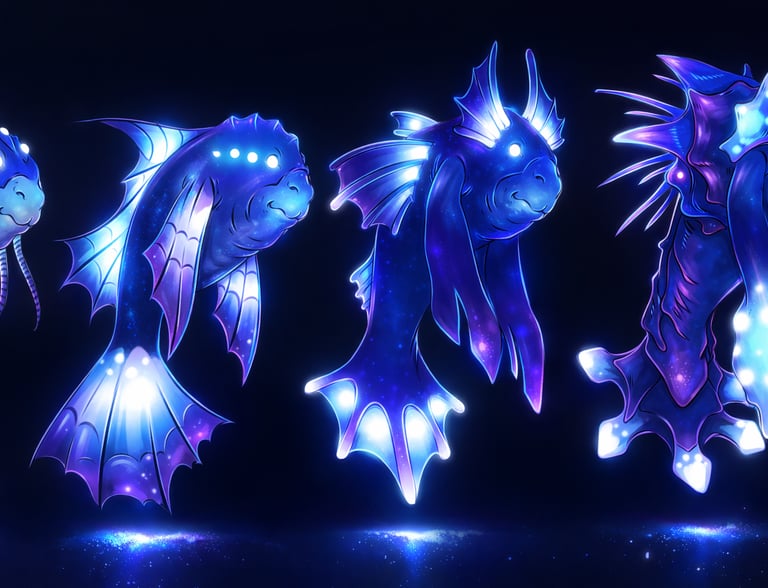
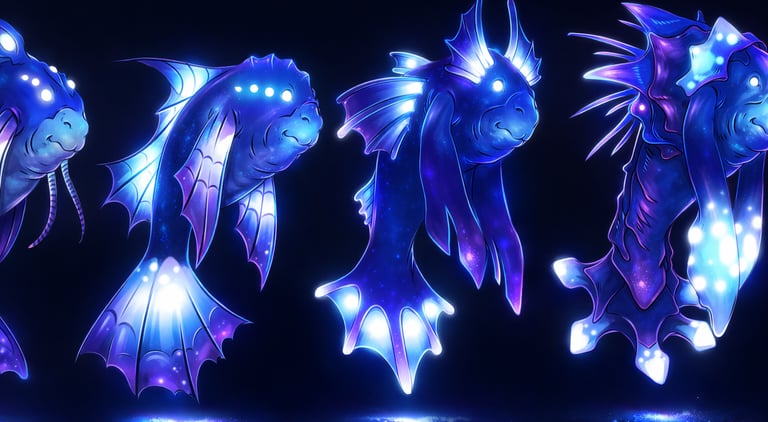
I defined the visual language of the park and established rules that guided asset creation across environments and creatures. Early creature concepts leaned toward alien forms, but after testing reactions, I shifted the foundation toward recognizable underwater animals—such as manatees, axolotls, and stingrays—layered with fantasy through glow, color schemes, additional fins, and surface detail. The overall visual approach relied on contrast between darkness and selective light, using fluorescent accents and glowing elements to express depth, scale, and progression while keeping projections readable in public spaces.
Systems & Technical Design
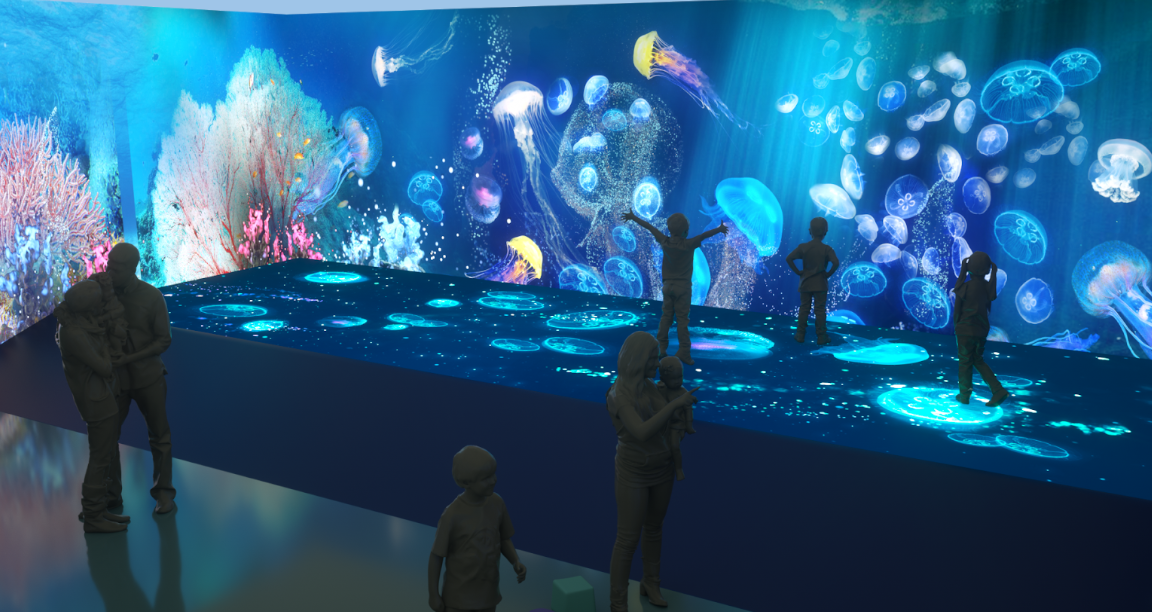
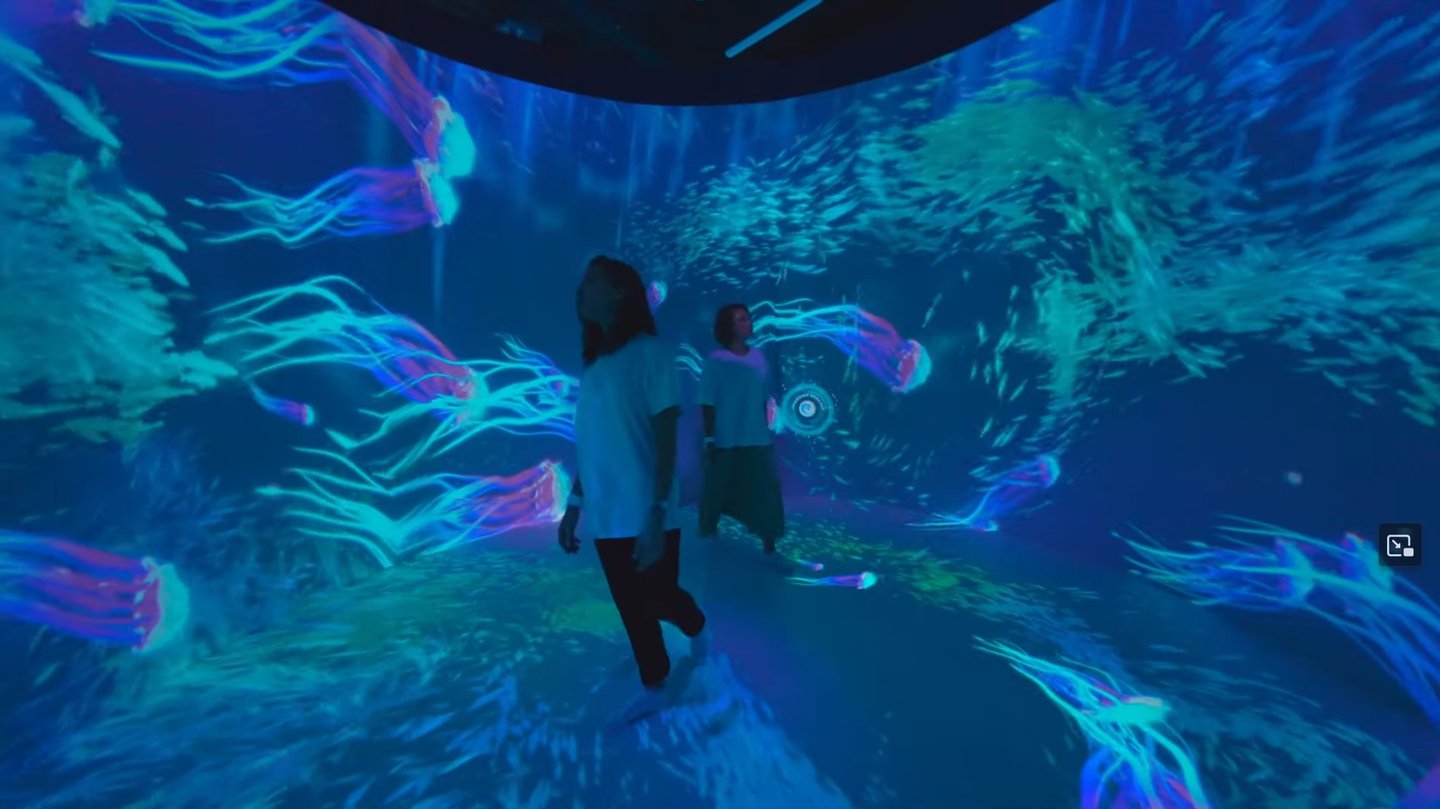
For large-scale scenes, I defined system-level approaches that avoided repetition and supported long-term stability. In the cylindrical submersion zone, this meant using real-time flock behavior and procedural spawning instead of fixed animation loops. I designed the architecture of nested spawners and behavioral rules so environment fragments and creatures appeared with controlled randomness in timing and position. Engineers implemented these systems, but the structure was driven by experiential requirements rather than technical convenience. I also proposed distortion-compensation strategies within the projection mapping system to reduce visible seams across complex, non-flat surfaces and multi-camera setups.
Production Communications & Hands-On Contribution
As Art Director, I worked across visual, interactive, narrative, and technical domains, acting as a connective layer between artists, developers, sound designers, engineers, and stakeholders. I provided visual guides, references, blockouts, behavior scenarios, and gameplay concepts, reviewed production output, and helped align teams around shared rules rather than isolated tasks. Alongside direction, I personally contributed through prototyping, compositional 3D blockouts, system design proposals, and hands-on problem solving under tight deadlines to ensure the park could be delivered and remain coherent as a complete experience.
Gameplay Design Across Interactive Zones
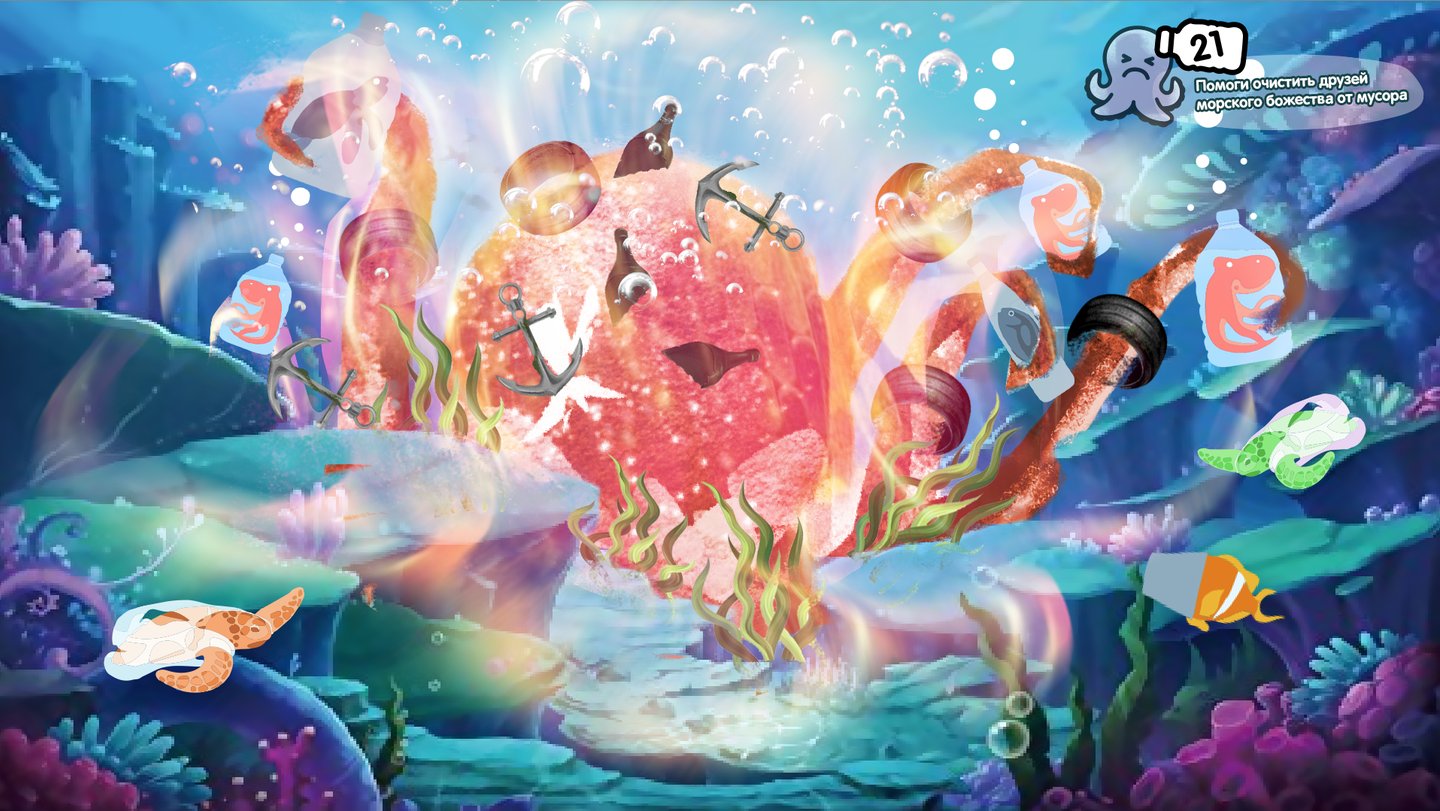
I was responsible for designing the gameplay logic of all interactive and game-driven zones in the park. This included defining player actions, feedback loops, difficulty scaling, and conditions for success or progression—such as guiding creatures, activating systems, collaborating with other visitors, or triggering large show sequences. Each interaction was designed to function both as a short, self-contained loop and as part of the broader journey, keeping gameplay readable, optional, and engaging for visitors with different levels of participation.
Narrative & Experiential Direction
I shaped Oceania Planet as a narrative journey that unfolds through space rather than explicit storytelling. The experience progresses from calm, inviting environments into darker and more uncertain depths, and later resolves toward openness and light at the surface. This arc guided decisions about lighting, color saturation, creature presence, motion intensity, and sound across all zones, allowing visitors to perceive a complete journey even when moving freely or encountering spaces out of order.
key decisions & Contribution
Persistent Character & Progression Systems
I shaped the concept and structure of the visitor character system: a creature created at the entrance, linked to an RFID bracelet, and summonable in multiple zones. The character reacted to gestures, appeared near the visitor inside projection spaces, and evolved visually through interaction and mini-games. Persistence across visits was a core part of the design, allowing returning visitors to reuse and develop the same character over time rather than starting from zero.
Art Direction & World-Building
I defined the visual language of the park and established rules that guided asset creation across environments and creatures. Early creature concepts leaned toward alien forms, but after testing reactions, I shifted the foundation toward recognizable underwater animals—such as manatees, axolotls, and stingrays—layered with fantasy through glow, color schemes, additional fins, and surface detail. The overall visual approach relied on contrast between darkness and selective light, using fluorescent accents and glowing elements to express depth, scale, and progression while keeping projections readable in public spaces.
Systems & Technical Design
For large-scale scenes, I defined system-level approaches that avoided repetition and supported long-term stability. In the cylindrical submersion zone, this meant using real-time flock behavior and procedural spawning instead of fixed animation loops. I designed the architecture of nested spawners and behavioral rules so environment fragments and creatures appeared with controlled randomness in timing and position. Engineers implemented these systems, but the structure was driven by experiential requirements rather than technical convenience. I also proposed distortion-compensation strategies within the projection mapping system to reduce visible seams across complex, non-flat surfaces and multi-camera setups.
Production Communications & Hands-On Contribution
As Art Director, I worked across visual, interactive, narrative, and technical domains, acting as a connective layer between artists, developers, sound designers, engineers, and stakeholders. I provided visual guides, references, blockouts, behavior scenarios, and gameplay concepts, reviewed production output, and helped align teams around shared rules rather than isolated tasks. Alongside direction, I personally contributed through prototyping, compositional 3D blockouts, system design proposals, and hands-on problem solving under tight deadlines to ensure the park could be delivered and remain coherent as a complete experience.
Gameplay Design Across Interactive Zones
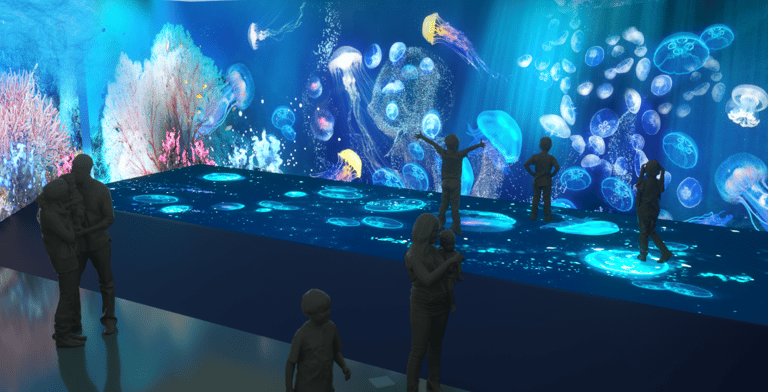
I was responsible for designing the gameplay logic of all interactive and game-driven zones in the park. This included defining player actions, feedback loops, difficulty scaling, and conditions for success or progression—such as guiding creatures, activating systems, collaborating with other visitors, or triggering large show sequences. Each interaction was designed to function both as a short, self-contained loop and as part of the broader journey, keeping gameplay readable, optional, and engaging for visitors with different levels of participation.
Promo video

Promo video
Or explore more of my work:
Or explore more of my work: